

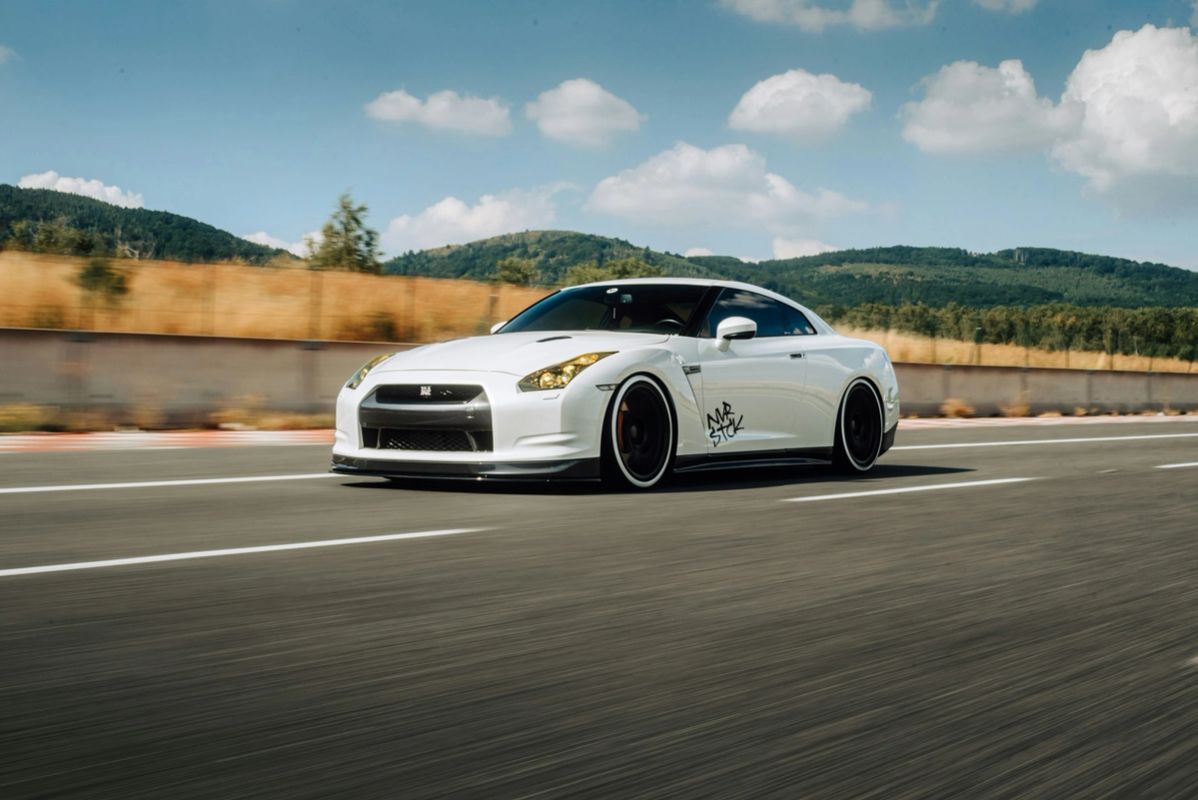
Performance Car Driving on Public Roads
You buy the power and prestige, but have you really thought about the challenges?

For many of us, the real fun of car ownership comes with a decent dollop of horsepower. Perversely though, those of us with powerful cars get a lot of satisfaction from hustling lower powered motors along without the benefit of an explosive right foot.
Do powerful cars need a different style of driving? In many respects no - if you treat them sensibly then a modern sportscar will treat you with respect in return.
However, when woken up, anything from a Golf GTi to turbo'd 911 will suddenly deliver an experience out of the ordinary. In the first instance everything happens more quickly. That overtake is taking half the time, that slip road is nowing disappearing under you in an instant - you need to have your wits about you and process everything much more quickly.
We've developed this guide because the mainstream advice you'll often find online doesn't address the realities of performance driving on public roads. As you'd expect we obviously recommend our advanced driving courses, but if nothing else, maybe this offers pause for thought.
The Differences
You need to understand traction control, drivetrain behaviour, how electronic systems actually intervene, and the specific observation skills that keep you and others safe when you're capable of deploying significant power.
Many performance car owners are surprised to discover that their driving approach needs refinement. The extra power doesn't come with extra control - quite the opposite.
The capabilities of modern cars might help save you from yourself, but start by understanding them.
The worst example I've seen of this is with some drivers of Nissan GTRs! The abilities of that car in particular are monumental. I've been overtaken by GTRs on track doing things that almost defy the laws of physics - being hustled through bends at warp speed. Which is fine, if only it didn't bestow the driver with such a false sense of talent and security.
Over the following sections, I'll explore the technical fundamentals that directly impact how you drive, from understanding what your drivetrain is doing beneath you to recognising the real limitations of electronic safety systems. We'll cover why wet-weather driving demands completely different technique, why driving modes exist beyond marketing, and crucially, why observation and planning become even more critical when you have the ability to accelerate and change direction aggressively.
The goal isn't to turn you into a racing driver (how many times do we have to draw the distinction?!). We're here to help you develop the awareness and technique to enjoy your car safely and responsibly.
The Drivetrain and How It Affects Your Driving
The driven wheels are obviously going to fundamentally change how your car behaves when being 'pushed'. I've spoken to Volvo drivers in the past who don't know if their motor is front-wheel-drive or read-wheel-drive. If you're not pushing the envelope then it won't matter to you.
If you want to 'press on' however, then be sure to know which wheels are driven, and if it's all four - what's the typical distribution. It fundamentally changes how the vehicle behaves under acceleration, braking, and cornering.
Rear-wheel-drive cars exhibit oversteer characteristics when pushed (rear end wants to come around); front-wheel-drive cars understeer (front wheels pushing on, despite your desire to rurn); more sophisticated all-wheel-drive systems attempt to manage both tendencies through active torque distribution.
These aren't academic distinctions because they directly determine how you need to position your car, how you should use the throttle while cornering, and how the vehicle will respond when grip limits are approached.
Modern all-wheel-drive systems in particular give a false sense of security. The technical sophistication of these systems is impressive, but they can't overcome the laws of physics. A heavy car carrying significant speed through a corner will still hit the limits of available grip. Too many performance car owners assume all-wheel-drive makes them invincible, then discover in adverse conditions that grip isn't the same as traction. Understanding your specific drivetrain's characteristics allows you to drive with confidence rather than surprise.
Driving in the Wet
Wet conditions represent a genuine test of performance car control because the factors that normally work in your favour: responsive steering, powerful acceleration, effective brakes, all become greater sources of risk.
The reduced grip available on wet tarmac means your margin for error shrinks dramatically. A car that feels planted and predictable in dry conditions can become nervous and unpredictable when water sits between the tyre and the road surface.
The fundamental principle of wet-weather driving in a performance car is restraint. Your inputs need to be smoother and smaller than you might naturally deploy. Steering lock must be applied gradually; throttle application needs genuine thought; even brake pressure should be considered and progressive. Many performance car drivers discover that their finely-honed dry-weather technique becomes a liability in the wet, because it's predicated on higher grip availability.
Traction and Stability Control
Electronic stability control is sold under various names like ESP, DSC, or VSC depending on the manufacturer. It represents one of the most significant safety advances in automotive history.
These systems continuously monitor wheel slip, vehicle rotation, and lateral acceleration, intervening with brake application and engine power reduction when they detect the car exceeding its grip limits.
However, performance car owners need to understand what these systems actually do, their limitations, and crucially, how to interact with them rather than fight against them.
Older, cruder systems could cut power in an unnerving way, newer systems might intervene with a mere flash of the warning light on the dashboard.
The critical understanding is that stability control is reactive, not predictive. The system responds after it has detected slip, which means there's an inherent delay between the moment you create a problem and the moment the system intervenes.
Any responsible performance car owner should rise above the nonsensical bravado of disabling stability control when on the road. Very, very few people have skill superior to ESP systems and in a variable environment like the real world, it's far more difficult to call upon those skills in comparison to the smooth, predictable environment of a race track.
Driving Modes and Electronics
Most performance cars now feature multiple driving modes such as Sport, Track, Comfort, Eco, each adjusting suspension stiffness, throttle response, steering weight, traction control sensitivity, and transmission shift timing.
These aren't marketing gimmicks; they represent genuine changes to vehicle dynamics. Understanding what each mode actually does - and more importantly, why you might choose a particular mode for the conditions you're driving in - is essential for confident performance car operation.
The misconception many performance car owners harbour is that Sport or Track mode should always be engaged. In reality, these modes are optimized for specific driving contexts. A wet public road is usually better navigated in Comfort mode, where reduced throttle sensitivity helps prevent wheelspin. Sophisticated drivers use modes contextually, understanding that being able to adapt the car's behaviour to the driving environment is far more valuable than having a single mode they permanently inhabit.
As Paul taught me in a session last year, selecting a 'sport mode' in the car - and in my head - is a very useful mechanism for switching between modes of high concentration and regular motoring modes. Get 'on it' for ten minutes during a more spirited drive then calm everything down again and turn off the mode in the car and in your head.
The Art of the Overtake
Overtaking in a performance car presents a unique set of challenges. The ability to accelerate decisively is genuinely valuable and it allows you to complete a pass quickly, minimising the time spent in the opposing lane.
However, this capability can become dangerous if deployed without proper planning and observation. The speed differential between a high-powered car and traffic can be deceptive; what feels like adequate space often isn't.
How many of us have found ourselves in a super powerful car, executed a textbook overtake, but then surprised ourseves with just how fast we've ended up travelling!?
With extreme power comes responsibility. My latest fun car - a 626bhp M5 - makes overtaking super tempting all the time. I'm having to be very grown up to exercise the restraint to overtake when necessary, when appropriate and without ending up at 100mph 3 seconds later.
Contrast that with the skill required to overtake without extreme power - that takes real planning and - arguably - greater skill.
Track Days vs Road Driving
This is one that I get a little agitated about.
It often comes up on driving tours. "Bob's a quick driver - he's done a lot of track days". Then I witness Bob executing mad overtakes and 'proving' his skill. Or "I overtook the racing driver" as if a racing driver should have a natural ability to drive fast on the road.
Aside from a greater appreciation of vehicle dynamics, the overlap between track and road is small.
Also on a track, the environment is controlled. There are there are no oncoming vehicles, no traffic, no trees, no pedestrians and probably a perfect road surface.
Road driving demands constant observation of variables beyond your immediate control and a skill of dynamic planning totally different from that employed on a racetrack.
Next time someone tells me they don't need coaching because they're good at go-karting, I might burst a blood vessel.
Bringing It All Together
The real skill in using a performance car in the real world is about finding 'flow'.
The thrill isn't gained from risk taking, it's gained from driving well. By being smooth, undramatic, 'invisible' to other road users - in their mirror, then gone - but without invoking the ire of others.
A performance car needs a performance mindset. That's a really difficult skill to master.
Photo by David Rybář on Unsplash
Updated:
« Back to Knowledgebase