

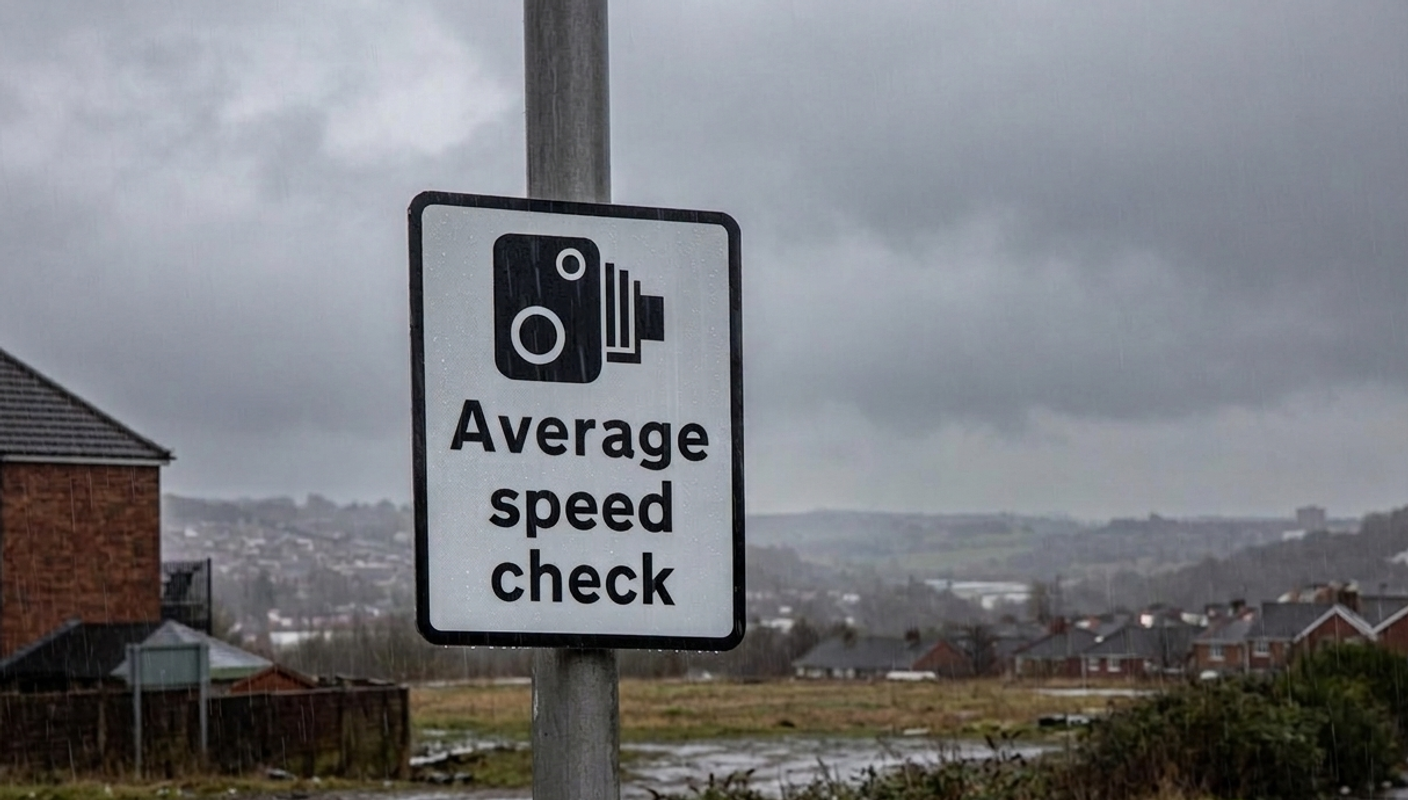
How do Average Speed Cameras Work
There's no point in just slowing down and speeding up again

We've all seen the yellow posts and cameras on the motorways; some of us might even have been caught by them... ☺️. Now they're not uncommon on stretches of A Road across the UK.
Aside from trying to understand the numpties who sail through them at warp speed, what is there to understand about the yellow enforcers?
What is an average speed camera?
An average speed camera measures how long your vehicle takes to travel a known distance between two or more fixed points, then divides distance by time. If the result is above the posted limit, a Notice of Intended Prosecution is generated automatically. There is no flash, no shutter sound, and no roadside warning that you've been clocked. The first you'll know about it is the letter on the doormat.
The technology behind it is Automatic Number Plate Recognition. Each camera in the zone reads your plate as you pass, timestamps it, and shares that record with the next camera down the line. The maths is trivial. The deterrent effect is the point.
How average speed cameras actually work
The two systems you'll meet on UK roads are SPECS and VECTOR, both made by the same manufacturer, both using ANPR-based average speed calculation between fixed points. SPECS launched first, in 2000, and is now the standard approach for speed enforcement in motorway roadworks. VECTOR followed in 2014 — physically more compact, mountable on existing lamp columns and traffic signals, and capable of enforcing red lights, bus lanes, yellow box junctions, tolling and congestion charging on top of average speed.
Both systems share a useful property for the people running them: they don't need a flash. SPECS and VECTOR cameras use invisible infrared illumination in failing light, so number plates can be captured in conditions that would defeat older film-based units. Rain, fog, dusk, dark — it doesn't matter. If you pass the cameras, you're in the system.
The zones can be short or very long. SPECS can calculate average speed over distances between 75 metres and 20 kilometres, with cameras appearing in sequence at least 200 metres apart. The longest deployment in the UK runs along the A9 in Scotland between Dunblane and Inverness, covering close to 99 miles. On a route like that, your average speed has to stay legal for the better part of two hours.
Why changing lanes doesn't work
This is the most enduring myth around average speed cameras, and it's wrong. The story goes that if you switch lanes between the entry and exit cameras, the system pairs your plate with the wrong vehicle and the calculation collapses. It used to have a sliver of truth — early SPECS units monitored one lane at a time, and a determined lane-hopper could occasionally confuse them.
That gap closed years ago. Modern cameras now use multiple sets at each point to track all the lanes and compare average speeds, so changing lanes does not defeat the calculation. Roadwork zones routinely deploy overlapping camera arrays specifically to close this loophole. Even if you somehow exit the zone without being paired, you've just spent the entire stretch driving erratically to dodge a fine you could have avoided by lifting off.
The other persistent myth is the 10% plus 2 mph tolerance. There is no statutory leeway. It is a myth that speed cameras allow a 10% plus 2 mph margin over the speed limit. Most forces apply something close to that in practice as guidance to officers, but it's discretionary, not a right, and there's nothing stopping a force from prosecuting at 1 mph over. Drive the limit. Not close to it.
Where they're used and why
Average speed cameras started life as a tool for motorway roadworks. They're still the default there, because they do something a single-point Gatso can't: they enforce compliance over the whole construction zone, not just at the camera location. Drivers can't slow for the camera and floor it between, because the camera is the entire road.
Their use has spread well beyond the motorway. Cambridgeshire was an early A-road adopter on the A14. Lincolnshire replaced fixed Gatsos with VECTOR on the A15 south of Lincoln. Nottingham, where SPECS was first trialled in 2000, now has eighteen streets under average speed enforcement, including residential roads. Wherever there's a stretch where sustained speeding causes a measurable casualty problem, average speed enforcement is now the cheaper and more effective answer.
It works, and the data is not subtle. Average speed zones have been shown to reduce speeding violations by up to 70% on the worst-performing stretches, and they smooth traffic flow by removing the brake-then-accelerate pattern that single-point cameras encourage.
What happens if you get caught
The standard penalty for a first speeding offence is three points and a £100 fixed penalty notice, or a speed awareness course if you're eligible and the speed is in the right band. If the calculated average exceeds the police threshold, a Notice of Intended Prosecution is created automatically and sent to the registered keeper. Higher speeds, or repeat offences, push you into court territory with larger fines and the risk of a ban.
There's no human judgement in the chain until the NIP lands on a desk for review. The camera doesn't know you were overtaking, doesn't care that the road was empty, and has no view on whether the limit felt reasonable. The number is the number.
The driver's job
The point of average speed enforcement is that it can't be gamed by reactive driving. You can't see the camera and slow down for it — you're being measured the whole way. The only way through clean is to set an appropriate speed at the entry and hold it.
For most drivers, that's harder than it sounds. Speedometer drift over a long stretch is real, particularly on motorways where 70 starts to feel sluggish and 78 feels normal. The fix is not vigilance over the speedo — it's calibrated awareness, the kind drilled into the Roadcraft system. Acceleration sense, planned overtakes, and an honest read of what the road can actually carry, all of which we cover on an advanced driving course.
Drive within the limit because the limit is correct for the conditions often enough that it's the safer default. The cameras are a backstop. If you're getting caught by them regularly, the cameras aren't the problem.
FAQs
Updated:
« Back to Knowledgebase