

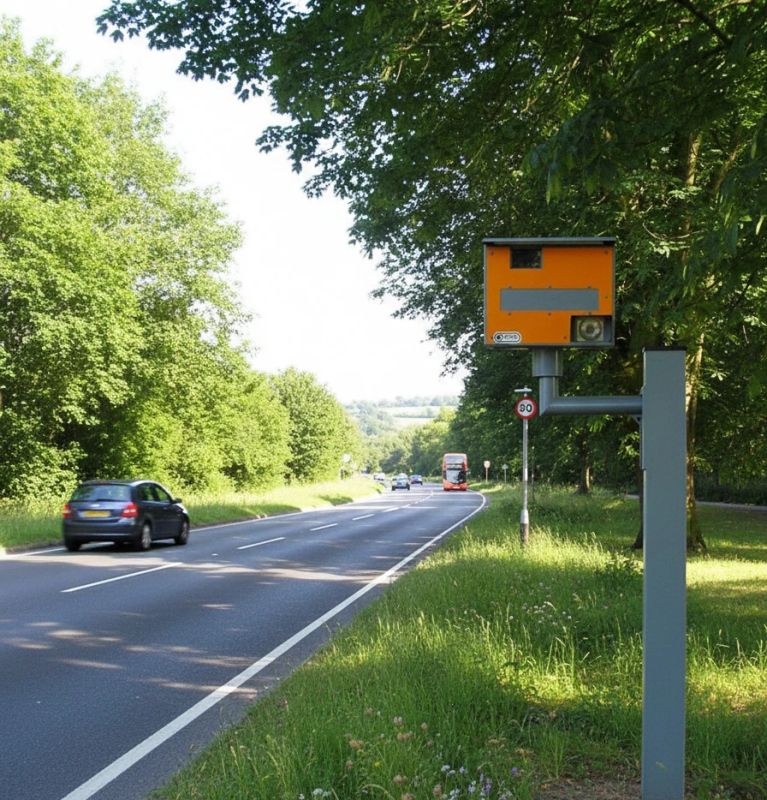
Speed Camera Tolerances
Just how sensitive are these cameras?

Speed Camera Tolerances in the UK: What Every Driver Should Know
Understanding the unofficial margins that could save you from penalty points
For any driver who spends time on Britain's roads, the sight of a speed camera is a familiar one. With approximately 7,000 cameras now deployed across the UK's road network, understanding how they operate and the tolerances that police forces apply has become essential knowledge. But whilst many motorists have heard of the so-called '10% plus 2' rule, few truly understand its origins, application, or limitations.
The Official Position: There Is No Tolerance
Let's establish one crucial fact from the outset: in law, there is no tolerance whatsoever. If a road has a 30mph speed limit, then travelling at 31mph is a speeding offence. The speed limit is an absolute maximum, and any driver exceeding it is technically breaking the law and liable for prosecution.
However, in practice, police forces across the UK apply operational discretion based on guidance from the National Police Chiefs' Council (NPCC), which superseded the Association of Chief Police Officers (ACPO) in 2015. This guidance exists for practical reasons rather than to give drivers licence to speed.
The NPCC Guidance: 10% Plus 2mph
The NPCC's Speed Enforcement Disposal Guidance, most recently updated in 2025, recommends that enforcement action should commence when a vehicle's speed reaches 10% above the posted limit, plus 2mph. This creates the following typical enforcement thresholds:
20mph zone: enforcement from 24mph (20 + 2 + 2)
30mph zone: enforcement from 35mph (30 + 3 + 2)
40mph zone: enforcement from 46mph (40 + 4 + 2)
50mph zone: enforcement from 57mph (50 + 5 + 2)
60mph zone: enforcement from 68mph (60 + 6 + 2)
70mph zone: enforcement from 79mph (70 + 7 + 2)
The Metropolitan Police confirmed through a Freedom of Information disclosure in April 2024 that they observe these NPCC guidelines, stating that this represents "the minimum speed at which enforcement is undertaken in all speed limits."
Why Does This Tolerance Exist?
The tolerance has its roots in vehicle construction regulations. Under the Road Vehicles (Construction and Use) Regulations 1986, vehicle speedometers must comply with either EC Community Directive 75/443 or ECE Regulation 39. These regulations permit indicated speed to exceed true speed by up to 10% plus 4km/h, whilst crucially stipulating that the indicated speed must never be lower than the actual speed.
In practical terms, this means your speedometer is legally permitted to show you travelling faster than you actually are, but can never show you travelling slower. If your speedometer reads 70mph, your true speed could be anywhere between approximately 63mph and 70mph. Manufacturers deliberately calibrate speedometers to over-read to ensure they never understate actual speed.
The NPCC guidance acknowledges this reality. According to official documents, the thresholds "provide suitable transparency in the approach to police enforcement, while allowing for some deviance from the posted limit" to account for these speedometer variations.
Variations Between Police Forces
Here's where enthusiasts need to pay attention: the NPCC guidance is exactly that, guidance. Individual police forces retain discretion over their enforcement approach. A Freedom of Information exercise in 2019 revealed notable variations:
The majority of responding forces confirmed they apply the 10% plus 2mph formula. However, Lancashire Constabulary and the Metropolitan Police indicated they use a 10% plus 3mph threshold. Several forces declined to disclose their thresholds, whilst others stated they have no standard threshold and apply case-by-case discretion.
More recently, West Midlands Police responded to FOI request 573A/24 confirming their adherence to NPCC guidelines, but emphasised that "tolerances exist, they do not and cannot replace police officers' discretion." The minimum enforcement speed "may be varied at any time."
Camera Technology and Detection
Understanding the camera systems themselves is equally important. The UK employs several distinct technologies, each with different operational characteristics:
Gatso cameras remain the most common fixed installation. Using radar technology combined with painted road markings, they capture rear-facing images when triggered. Modern digital Gatso units replaced the original film-based cameras from 2007 onwards, meaning they never run out of capacity.
HADECS 3 (Highway Agency Digital Enforcement Camera System 3) cameras are deployed on smart motorways and have earned the nickname 'stealth cameras' due to their compact size and elevated mounting positions. Crucially, these systems can adjust their detection threshold in real-time to match variable speed limits, receiving information from sensors further along the carriageway.
Average speed cameras (SPECS) calculate your speed over a measured distance rather than at a single point. Mounted on gantries at intervals typically exceeding 200 metres (though SPECS 3 units can operate at just 75 metres apart), they use infrared imaging that doesn't produce a visible flash. The mathematics are straightforward: if the distance is one mile and you cover it in less than 60 seconds in a 60mph zone, you've been speeding regardless of where you lifted off.
Mobile speed cameras operated from vans can detect vehicles from up to one kilometre away, making them the longest-range enforcement tool in the UK arsenal. These may use mini Gatso units, laser guns, or handheld radar equipment.
The Legal Framework
Speed camera equipment in the UK must comply with Home Office Type Approval requirements. The Government's Speedmeter, Traffic Light and Prohibited Lane Enforcement Camera Handbook, published by the Department for Transport, sets out the technical standards and operational requirements for all enforcement equipment.
Standard penalties for speeding offences are a £100 fine and three penalty points. For speeds within certain thresholds above the limit, drivers may be offered a Speed Awareness Course as an alternative to points. The Notice of Intended Prosecution must be issued within 14 days of the alleged offence, a requirement that applies regardless of whether the detection was by camera or officer.
The Enthusiast's Perspective
For driving enthusiasts, the existence of tolerances raises an obvious question: can you rely on them? The unequivocal answer is no. The tolerance is operational discretion, not a legal entitlement. Attempting to use the tolerance as a defence against a speeding charge will fail because you were, by definition, exceeding the legal limit.
What the tolerance does provide is a buffer against genuine speedometer error. If your car shows 32mph in a 30 zone and the camera registers 31mph actual, you're unlikely to receive a ticket. But deliberately driving at indicated speeds that bring you close to the enforcement threshold is playing a losing game with your licence.
Consider also that enforcement priorities can change. The NPCC guidance explicitly states that thresholds "may be varied at any time." The recent rollout of 20mph limits in residential areas across approximately 80% of UK councils has brought renewed focus on lower-speed enforcement.
Conclusion
The 10% plus 2mph guideline represents a pragmatic accommodation between the absolute nature of speed limits and the practical realities of vehicle instrumentation. It is not permission to speed, nor a guaranteed safe margin. Police forces retain full discretion to enforce at any speed above the posted limit.
For those who value their driving privileges, the only sensible approach is to treat the posted limit as exactly that: the maximum permissible speed. Your speedometer's tendency to over-read provides an inherent safety margin; there's no need to seek additional latitude from enforcement tolerances.
The cameras are there. They work. Drive accordingly.
Sources
- NPCC Speed Enforcement Disposal Guidance 2025 (College of Policing Library)
- Metropolitan Police FOI Disclosure: Speed Camera Thresholds (April 2024)
- West Midlands Police FOI Response 573A/24
- GOV.UK: Speedmeter, Traffic Light and Prohibited Lane Enforcement Camera Handbook
- Road Vehicles (Construction and Use) Regulations 1986
- UK Parliament Hansard: Speedometer Accuracy (March 2001)
- RAC Foundation: FAQs about Road Traffic Law Enforcement
Updated:
« Back to Knowledgebase