

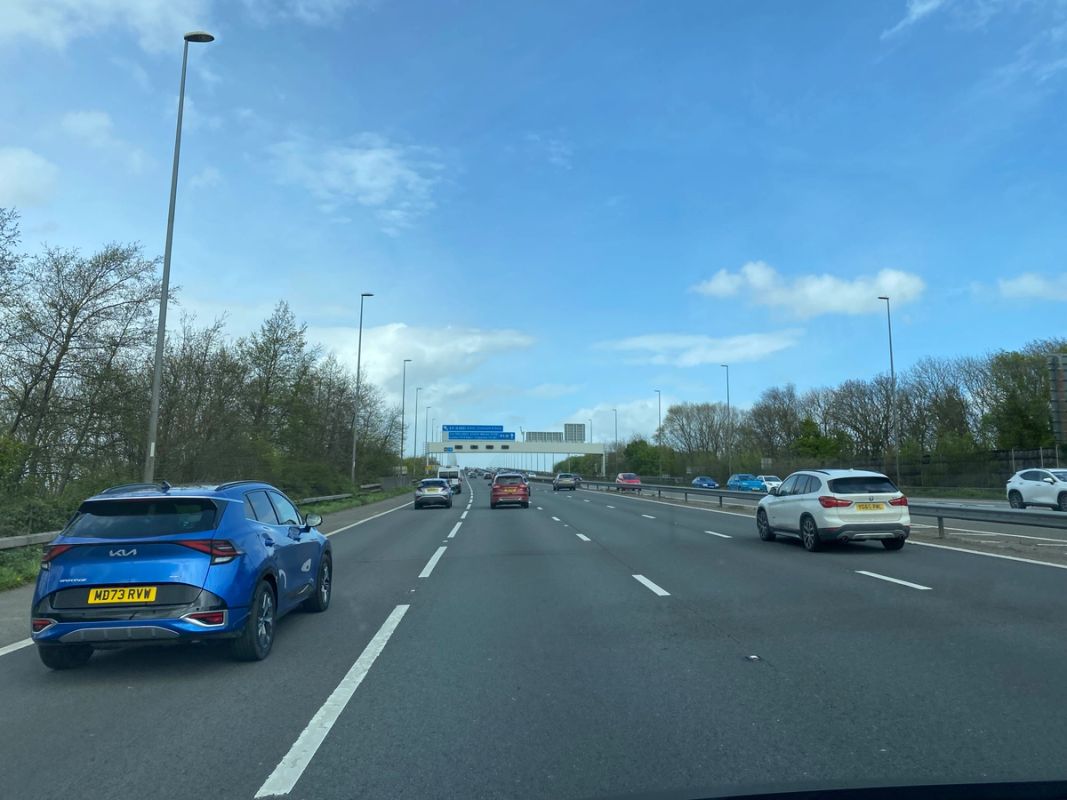
Motorway Driving for New Drivers
A Practical Guide
Parents, overwhelmingly, worry most about motorways.
The logic seems obvious — faster speeds, more traffic, larger vehicles, less margin for error. The instinct to keep a new driver off them for as long as possible is almost universal.
The data says the opposite. UK motorways are the safest road type for every age group, young drivers included. According to the Department for Transport's 2024 younger driver factsheet, the overwhelming majority of young-driver casualties occur on rural and urban single-carriageway roads. Motorways account for a small fraction of young-driver KSI incidents despite being the road type on which the most miles are driven at the highest speeds.
The real risk for your son or daughter isn't the M5 on a Tuesday morning. It's the unlit B-road back from a friend's house on a wet Thursday evening. This guide explains why motorway driving, done properly, is the least of your worries — and how to make sure your young driver is one of the ones doing it properly.
The rules have changed; most drivers haven't caught up
Two significant things have changed about UK motorway driving in the last ten years, and young drivers are often more up to date on them than older drivers are.
Learners can now take motorway lessons. Since June 2018, learner drivers have been allowed on motorways with an approved driving instructor in a dual-controlled car. Many driving schools don't offer this as standard, so whether your child has driven on a motorway before their test varies enormously. Ask them. If the answer is no, their first motorway trip will be their first motorway trip, and planning it matters.
Smart motorways exist, and most of them are here to stay. Around 10% of England's motorway network is now smart motorway, across roughly 375 miles. The 2023 government decision to stop building new smart motorways doesn't affect the ones already in operation. Your young driver will encounter them, so they need to know how they work.
The three types of smart motorway
Getting this bit right matters because the rules differ meaningfully between them, and the penalty for getting it wrong can be six points — which under the New Drivers Act 1995 would revoke a new driver's licence on the spot.
Controlled motorway
These have variable speed limits displayed on overhead gantries, but keep a permanent hard shoulder. The hard shoulder is for emergencies only; the main lanes operate like a conventional motorway with variable speed limits enforced by overhead cameras. This is the least controversial type.
Example routes: parts of the M25 between junctions 16 and 23, and between 27 and 30.
Dynamic hard shoulder (DHS)
On these, the hard shoulder opens as a running lane at busy periods. Overhead gantries indicate whether it's open (with a speed limit displayed above it) or closed (Red X or blank sign). If no signal is showing above the left lane, it's a hard shoulder — don't drive in it except in an emergency.
The government committed to converting remaining DHS sections to all-lane running by 2025, but following the 2023 decision to halt new construction, that programme has stalled. Some DHS sections remain in operation.
All-lane running (ALR)
The controversial one. The hard shoulder has been permanently converted to a running lane. There is no hard shoulder. Emergency Refuge Areas (ERAs) are the only designated stopping points, spaced roughly every 1–1.6 miles.
If a lane is closed ahead, it'll be marked with a Red X on the gantry. Ignoring a Red X is £100 and six penalty points, enforced automatically 24/7. There is no grace period. For a young driver in their first two years — when six points means automatic licence revocation and a full retest — ignoring a Red X is one of the worst things they can do on a motorway.
Example routes: significant stretches of the M1, M3, M4, M6, M25, M42, and M62.
What to do if something goes wrong on a smart motorway
This is the bit every young driver should know cold, because the window to make good decisions is short.
Warning light or the car feels wrong
Leave the motorway at the next junction if you possibly can. Don't stop on the motorway if the car can still drive safely. This is the single most important piece of advice on the whole page. Most breakdowns give warning — a light, a noise, a loss of power — and the right response is almost always "get off at the next exit."
If you can't make the next junction
On a conventional motorway with a hard shoulder: pull onto the hard shoulder as far left as possible, hazards on, exit via the passenger side, stand behind the safety barrier, call for help.
On an all-lane running section: aim for an Emergency Refuge Area. They're orange-surfaced laybys, signed with a blue sign and an orange SOS phone symbol. ERAs are safer than the old hard shoulder because they're set back from the live lanes. Use the SOS phone — it connects directly to the control centre, which can close the lane overhead.
If you can't reach an ERA
Get as far left as possible, tight to the verge. Hazards on. If it's safe to exit — no barrier behind you blocking the left door, and traffic behind isn't immediately closing — get out via the left-hand side, behind the barrier if there is one, away from the car. Call 999.
Do not sit in the car in a live lane. Stopped Vehicle Detection radar systems now cover the majority of ALR sections and will usually close the lane within 20–60 seconds, but the BBC Panorama investigation in 2024 documented incidents where the technology failed for extended periods. Standing behind a barrier is safer than sitting in a car in a live lane.
The skills that matter most on a motorway
Speed on a motorway is less of an issue than most parents assume. Modern cars are stable and comfortable at 70mph. What actually matters are the handful of skills that get young drivers into trouble.
Lane discipline
The left lane is for driving. The middle and right lanes are for overtaking. After overtaking, you return to the left.
This sounds obvious. It isn't observed consistently by most UK drivers, and one of the most common bad habits a young driver will pick up by copying the drivers around them is middle-lane hogging. Middle-lane hogging is technically an offence (careless driving) and carries a £100 fine and three points.
The correct lane-use principle taught in Roadcraft is: move into the overtaking lane decisively when there's a clear reason to (catching up with slower traffic, a planned overtake), and move back to the left as soon as the overtake is complete. Continuously flowing back into the left lane is the mark of an advanced driver.
Joining a motorway
The slip road is for accelerating to motorway speed. By the time you reach the end of the slip road, you should be doing 60–70mph (traffic permitting), matched to the speed of the traffic in lane one, and merging into a gap that you identified early.
Common mistakes:
- Entering the slip road too slowly and arriving at the motorway at 40mph, unable to merge
- Looking over the shoulder at the last moment instead of planning the merge from halfway down the slip
- Stopping at the end of the slip road because no gap has appeared (almost never the right call — a rolling merge at speed is safer than a stationary start from a slip road)
The skill to teach: assess the motorway traffic from the top of the slip road, plan the merge, accelerate to match, flow in. Roadcraft covers this explicitly as part of information-observation-anticipation.
Exiting a motorway
Signal in good time, move into the left lane early, enter the slip road at motorway speed, then decelerate on the slip road itself.
The common error — and it's worth specifically warning a young driver about — is exiting the motorway and continuing at 70mph onto a slip road rated at 50mph, or onto a roundabout at the end of the slip where the driver needs to be doing 20mph. After an extended period at motorway speed, everything feels slower than it is. Check the speedometer on the slip road.
Following distance
The two-second rule, measured by picking a fixed point the car ahead passes and counting "only a fool breaks the two-second rule" before you reach the same point. In wet or poor conditions, double it.
On a motorway at 70mph, two seconds is about 62 metres. Most UK drivers leave less than this routinely. A young driver who maintains genuine two-second gaps — and doesn't let other drivers bully them out of it by cutting in — will avoid the majority of the rear-end collisions that make up most motorway incidents.
Reading ahead
Look well beyond the car immediately in front. Brake lights three or four cars ahead give you several seconds of warning that the traffic is slowing — much more time than waiting for the car directly in front to brake.
This is one of the specific skills that advanced Roadcraft-based coaching develops: scanning the far distance and using that information to smooth out your own driving. A young driver who learns to drive "on the car two cars ahead" rather than on the car in front ends up with a smoother, safer, and faster drive.
Variable speed limits and Red X signs
On any smart motorway, overhead gantries can display variable speed limits (60, 50, or 40 in a red circle) and Red X signs closing specific lanes.
Variable speed limits are legally enforceable, not advisory. HADECS 3 cameras mounted on the gantries enforce them continuously. If the gantry says 50, the limit is 50.
Red X means do not drive in that lane. Move out as soon as it's safe. Ignoring a Red X is £100 and six points — half of a full licence's allowance, all of a new driver's allowance. Automatic enforcement, no grace period.
A common young-driver mistake is seeing the Red X, assuming it's advisory, and continuing. It isn't advisory. If you see one, move left or right out of that lane immediately and stay out until a gantry further along shows a clear signal or a speed limit.
Motorway driving in bad weather
Wet: double your following distance, lights on if visibility is reduced, watch for standing water and spray.
Fog: headlights on dipped, fog lights only if visibility drops below 100 metres (the length of one motorway marker post), extra following distance. If fog is genuinely dense, leave the motorway at the next junction and wait it out.
Snow and ice: if there's any genuine doubt about conditions, don't. The motorway will still be there tomorrow. Young drivers in particular have no body of experience to draw on for judging grip in winter conditions, and a skid at 70mph in the outside lane has no good outcomes.
Why motorway fear is worth addressing directly
The AA's analysis of smart motorway data in early 2026 found that driver anxiety on all-lane running motorways continues to increase, and that the proportion of drivers feeling nervous on them has roughly doubled in 12 months. Some of that anxiety is justified — two specific ALR schemes (M3 J2–4a and M1 J39–42) have shown worsening KSI numbers since opening. Most of it isn't: the overall motorway network, smart sections included, remains statistically the safest road type in the UK.
The problem with motorway fear in young drivers is that it leads to avoidance. A 2022 survey cited by the RAC found that 41% of young drivers knew friends who were so nervous about motorways they refused to drive on them. Avoidance doesn't keep them safe — it pushes them onto exactly the rural A-roads where the actual statistical risk lives.
This is one of the specific things a one-day advanced course can change quickly. Structured motorway driving with a coach giving continuous feedback, in the young driver's own car, typically converts motorway anxiety into confidence inside a few hours. The long-term benefit is that they then use the motorway network for longer journeys instead of threading cross-country on faster, less-suitable A and B roads.
Where to go next
Motorway driving done well is one of the lower-risk things a young driver does. Rural driving — the road type this guide hasn't covered — is the higher-risk one, and the place a day of advanced coaching pays off most.
Book a DMAP1 day for your young driver →
Other guides in this series:
- Young Driver Training: The Complete Guide for 17–25 Year Olds — the overview piece
- Pass Plus vs Advanced Driving Courses: Which Is Right for a Young Driver? — honest comparison of the options
- Young Driver Insurance: How Advanced Training and Telematics Reduce Premiums — what insurers actually recognise
- Rural Road Safety: Why Country Roads Are the Biggest Risk for Young Drivers — the road type that actually matters most
Questions? Call us on [number]. We're happy to discuss whether a coached motorway session makes sense for your situation.
Sources: DfT Reported road casualties in Great Britain: younger driver factsheet 2024; AA analysis of smart motorway reports, February 2026; National Highways smart motorway guidance; RAC smart motorway coverage 2026; gov.uk smart motorway guidance; Highway Code.
Frequently Asked Questions
Updated:
« Back to Knowledgebase