

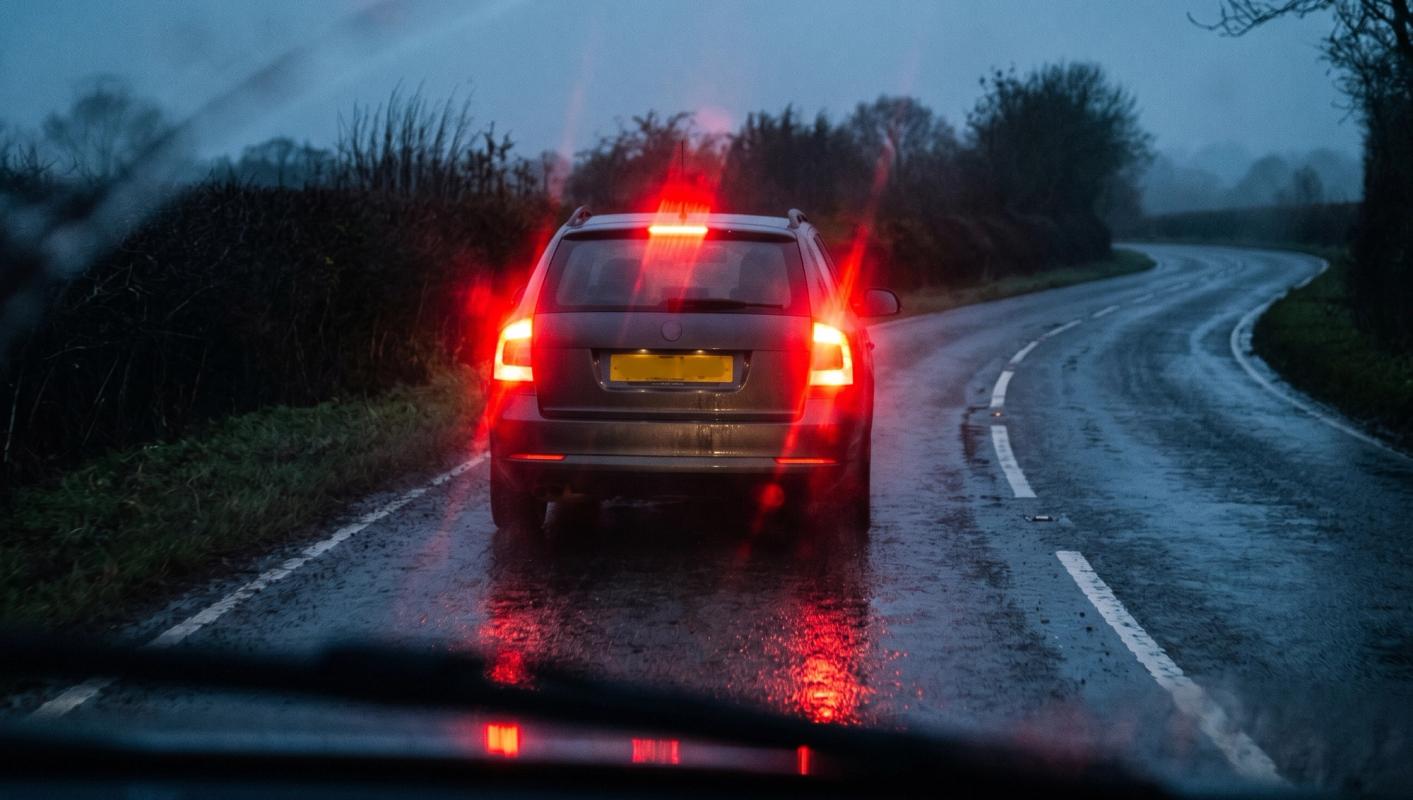
EU mandates flashing brake lights from July
What it tells us about the driver behind you

From 7 July 2026, every new car registered in the European Union must flash its brake lights under heavy braking. The rule sits inside the EU's General Safety Regulation and looks, at first glance, like a small change. Read the rest of the package alongside it and it says something rather blunter about the driver in your rear-view mirror.
What the rule actually does
When a new EU-registered car brakes hard above 50 km/h, or its ABS engages, the rear lights will pulse rapidly instead of glowing steadily. Once the car stops, the hazards take over automatically.
The European Commission's reasoning is plain enough. Rear-end shunts are one of the most common collision types on EU roads, and a sharper visual cue gives the following driver a fraction of a second more to wake up and react.
The function only applies to new vehicles registered from 7 July onward. If you already own a car, nothing changes. Several manufacturers, Mercedes, BMW and Volvo among them, have offered a version of this for years, and the EU is now making it baseline rather than badge-engineering.
It arrives bundled with a broader set of mandates that take effect on the same date: automatic emergency braking, lane-keeping assist, driver fatigue and inattention warnings, Intelligent Speed Assist, an event data recorder, and the wiring for a future alcolock interlock. The EU estimates the wider package will prevent 25,000 deaths and 140,000 serious injuries by 2038.
The slightly awkward subtext
Read the whole list together and a pattern surfaces. Each system targets a specific failure mode in the driver: not looking far enough ahead, drifting out of lane, switching off mentally, missing a speed limit, misjudging a stop, driving impaired. The regulator has gone through the catalogue of crash causes and bolted a piece of silicon next to each one.
That is a reasonable response to a real problem. UK road deaths have barely shifted in a decade, and the rest of Europe tells a similar story. If drivers as a population aren't getting any better, the cars have to.
It does leave one slightly awkward question hanging. Flashing brake lights work because the driver behind you might not be paying enough attention to read a steady one. Lane-keeping assist works because drivers drift. Fatigue alerts work because we press on when we shouldn't. Each system is, politely, a workaround for a habit that used to be the driver's job.
What good drivers already do
A properly observed road rarely produces a true emergency stop in the first place. You see the brake lights two cars ahead. You see the pedestrian glance toward the kerb. You see the lorry's indicator come on before it pulls out. The two-second rule, doubled in the wet, exists precisely so that a hard stop in front of you becomes a firm stop for you, not a panic one.
Flashing brake lights are useful belt-and-braces. They are no replacement for looking far enough up the road to know what's already coming.
Why the package matters anyway
There's a tendency among keen drivers to roll their eyes at this kind of legislation. Lane-keeping nudges the wheel when you're being deliberate about a line. Speed-limit warnings bong at you for nudging two over on a clear B-road. The fatigue camera is, allegedly, watching you blink.
The honest answer is that these systems aren't really aimed at trained drivers. They're aimed at the bulk of the driving population who, on the available evidence, have stopped improving. Bringing the floor up by mandate is probably the only lever a regulator has left, given the alternative is doing nothing while the casualty figures plateau.
So the flashing brake light shouldn't read as a slight on you. Think of it as a small tax on the inattentive driver behind, and probably a sensible one.
The Driving Masters view
Technology that catches errors is welcome. Technology that masks the underlying skill gap is the part to watch, because the skill gap is what kills people. A car that does more of the work raises the floor. It does not raise the ceiling. On a wet B-road in the Cotswolds, with a tractor over the next crest and a cyclist round the bend, the ceiling is what matters.
Our coaching is built on the idea that competent drivers should not need their car to save them. The flashing brake light is a fine piece of engineering. The aim of advanced training is to never trigger one in the first place.
Updated:
« Back to News