

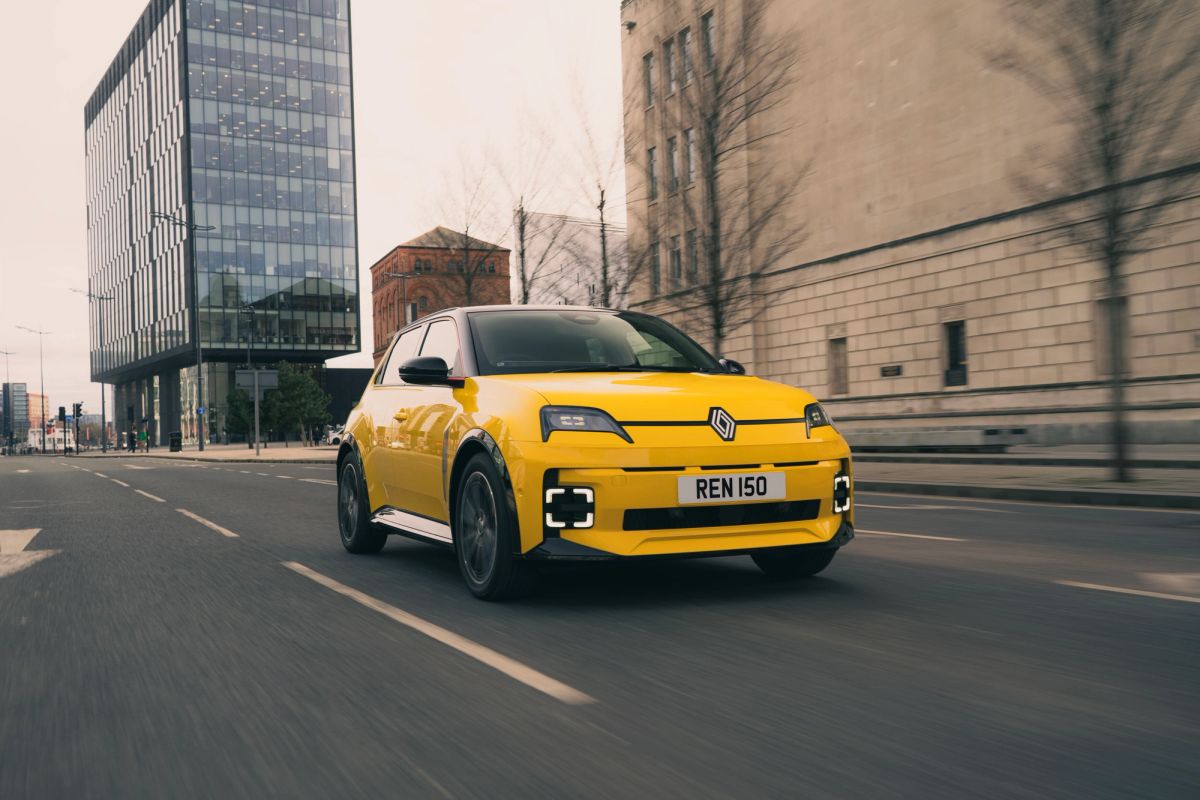
One-pedal driving comes to the Renault 5
Who needs a brake pedal?!

Renault has added one-pedal driving to the Renault 5 E-Tech as standard on techno+ trim and above, following its debut on the Renault 4 E-Tech earlier in the year.
The feature lets the driver slow the car and bring it to a complete stop using only the accelerator pedal. It is also the kind of change that quietly rewrites a driver's habits.
What one-pedal driving actually does
Lift off the accelerator in a normal car and the vehicle coasts - subject to a bit of engine braking shaving off some speed. Lift off in an EV with one-pedal mode active and the regenerative braking ramps up hard enough to slow the car decisively, all the way to a halt if you keep your foot off.
The brake pedal is still there for emergencies and for the firmest stops, but most everyday deceleration happens through accelerator modulation alone.
On the R5, this is now the fourth level of regenerative braking available, sitting above the standard three modes. The driver can switch it on or off via the paddles behind the steering wheel.
Why this matters beyond the R5
Renault is not the first to do this. Nissan's e-Pedal, BMW's B-mode, the Tesla single-pedal experience and Volkswagen's ID range have all offered versions of it. What is significant about the R5 is the price point. The R5 starts at around £23,000 and is currently the UK's best-selling EV by registrations, according to the SMMT's April figures. One-pedal driving is moving from premium and enthusiast EVs into the mainstream small-car market.
That has implications for how a generation of new drivers will learn to read deceleration.
How it changes the driver's habits
Once you adapt, two things happen. The first is that you start anticipating earlier. The accelerator becomes a continuous slowing input rather than a binary on or off, so you read the road further ahead to feather the lift. The second is that your right foot does almost everything. In urban driving, you can go entire journeys without touching the brake.
That sounds like a Roadcraft win, and in some ways it is. Smooth, anticipatory driving is the goal of any advanced course, and one-pedal mode rewards exactly that pattern. It also reduces brake wear and extends range through energy recovery.
But there are trade-offs worth being aware of.
What to watch out for
When you switch back to a non-EV, or to an EV with one-pedal off, the muscle memory needs adjusting. Drivers used to lifting and stopping can find themselves coasting further than expected. In a car they have only just got into, that gap between expectation and behaviour is where avoidable contact happens.
The brake lights are another quirk. On most one-pedal systems, the brake lights illuminate when the deceleration is firm enough to warrant it, but the threshold varies by manufacturer. Drivers behind you may not always see the same signal they would expect from a conventional brake application. The EU's new mandatory flashing brake light rule, also coming this summer, will help with the most aggressive stops, but the principle still applies: a smooth one-pedal stop can leave the driver behind reading the gap rather than your lights.
Following distance, doubled in the wet, remains the sensible margin.
The Driving Masters view
One-pedal driving is a useful skill addition rather than a replacement for the fundamentals. The drivers who get the most out of it are the ones who already drive smoothly, look far up the road, and brake progressively. The pedal change rewards the technique. It does not teach it.
For anyone moving from a conventional car to an EV, especially a first-time EV driver, an hour or two of practiced adaptation makes the difference between fighting the car and flowing with it. The R5 is going to put that adaptation in front of a lot of new drivers very quickly.
Updated:
« Back to News