

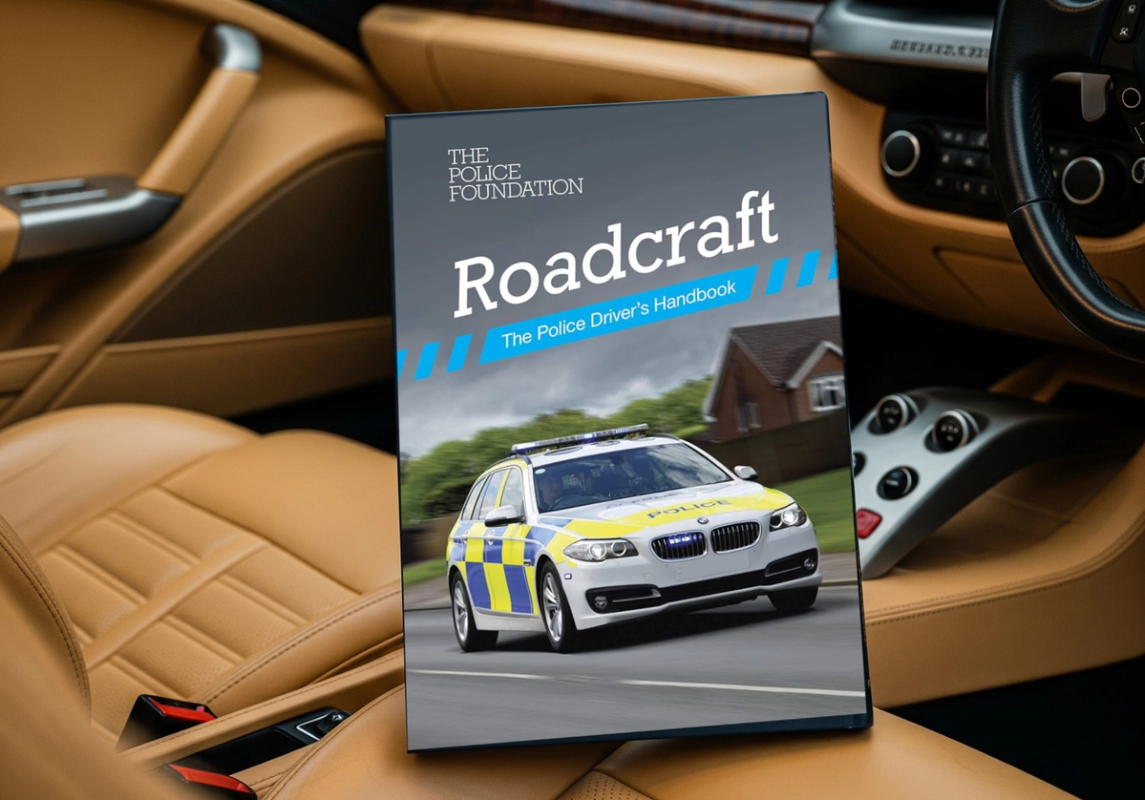
What is Roadcraft?
Roadcraft is the advanced driving method of safe, systematic hazard negotiation, used and taught by UK police

Roadcraft is the UK police driving system, written by police, used by every emergency service, and the foundation of every credible advanced driving course in Britain.
If you've ever wondered what separates a police pursuit driver, a paramedic on a blue-light run and a road-rally instructor from someone who passed their L-test and never thought about driving again, the answer is Roadcraft.
It's a book. It's also a system. And it's the reason the British police have, for nearly seventy years, produced some of the most capable drivers in the world.
The Handbook
The full title is Roadcraft: The Police Driver's Handbook. It's published by The Stationery Office on behalf of the Police Foundation, with a working group of serving and former police instructors guiding each edition.
The current edition landed in November 2025 and is a significant update. It adds new chapters on Advanced Driver-Assistance Systems (ADAS) and electric vehicle dynamics, alongside refreshed guidance on observation, planning and operational stress. It's the gold standard, and not just by reputation. Every UK police force, every fire service, every NHS ambulance trust and the armed services train against it.
You don't have to be a copper to buy it, anyone can. It the price of a couple of pints it will change the way you think about every journey you've ever made.
A Short History
The origins go back to Lord Cottenham's work at the Hendon Police Driving School in 1937. He'd noticed that the Metropolitan Police's accident rate was climbing as cars got faster, and he set out to fix it by training drivers to think in sequence: position, speed, gear, acceleration, each one informed by what was happening ahead.
The accident rate fell. A former Hendon instructor, Jock Taylor, published Cottenham's notes in 1954 as Attention All Drivers!, and a year later the first edition of Roadcraft appeared. Nine editions later, the system has been refined but the bones are unchanged. What worked in 1955 still works in a 2026 Porsche Taycan.
The System of Car Control: IPSGA
The core of Roadcraft is a five-phase sequence applied to every hazard you meet. The phases are taken in order, and the earlier phases run continuously throughout.
Information. Take it in, use it, give it. Observation, mirrors, signals, communicating with other road users. This phase never stops. Everything that follows depends on it.
Position. Place the car for the best view, the best safety margin, and the best line through whatever's coming. Position is your insurance policy.
Speed. Adjust speed so you can always stop in the distance you can see to be clear. Not the limit. The right speed for the moment.
Gear. Once speed is set, select the gear that gives full control through the hazard. One gear change, not a sequence of them. The Roadcraft principle is to brake and then change, not change while braking.
Acceleration. Out of the hazard, smoothly, in the gear you selected, when it's safe to do so.
The point of the system isn't that it's clever. It's that it's repeatable. Under pressure, fatigue, weather, or a screaming patient in the back, the system gives the driver a structure to fall back on. As one of our instructors puts it: under pressure, you don't rise to the occasion. You fall to the level of your training.
What sits underneath the system
IPSGA gets the attention, but Roadcraft rests on a wider set of skills the handbook treats as equally important.
Observation and anticipation. Reading the road two, four, ten seconds ahead. Cyclists you can't yet see. The driver three cars ahead braking. The geometry of the bend before you enter it.
Hazard perception and planning. Not just spotting hazards. Predicting them. Planning around them before they happen.
Vehicle sympathy. Driving the car you have, not the car you wish you had. Smooth inputs, understanding weight transfer, getting the most from the machine without abusing it.
Self-assessment. Roadcraft drivers debrief themselves after every drive. What did I miss? What would I do differently? It's the habit that turns a competent driver into an exceptional one over a career.
Concentration. The discipline of staying engaged for hour eight as much as hour one.
Who Roadcraft is for
Officially, the handbook is for police, emergency services and the armed forces. In practice, it's the curriculum behind every serious civilian advanced driving qualification in the UK. RoSPA Advanced Drivers and Riders and IAM RoadSmart both teach to it. So do we.
You don't need to be planning to drive a fire engine to benefit. Roadcraft is for any driver who's looked at the standard they were trained to at seventeen and decided it isn't the standard they want to drive at for the next fifty years.
That includes parents who want their new-driver son or daughter to leave with more than the bare minimum. Confident drivers who suspect there's a level they haven't reached. Performance car owners who've worked out that owning a 911 doesn't automatically mean driving one well.
Learning Roadcraft
You can read the handbook. We'd recommend it. But Roadcraft is fundamentally a practical discipline, and reading about IPSGA is to driving Roadcraft what reading about swimming is to swimming.
The way it's learned is the way the police learn it: one-to-one, with a qualified Roadcraft coach, on real roads, getting commentary and correction in real time. Our coaches come from police, military, emergency services and motorsport backgrounds. Every one of them holds a current advanced qualification, and several have contributed to the modern editions of the Roadcraft handbook itself. Colin in West Lothian is one of them.
If you'd like to learn Roadcraft properly, we run three advanced driving courses:
- New Driver — for drivers in their first two years, building Roadcraft fundamentals on top of L-test habits.
- Confident Driver — for experienced drivers who want to drive at a genuinely advanced standard.
- Total Driving — Roadcraft applied to performance cars, fast roads and the limits of grip.
Each one is a day with a coach, in your own car, on roads near you. You'll leave driving differently.
Further reading
- Buy the Roadcraft handbook — the official site.
- What is advanced driving? — how Roadcraft fits into the wider picture.
- Meet our instructors — every one Roadcraft-trained.
- Take an advanced driving course.
Updated:
« Back to Knowledgebase